
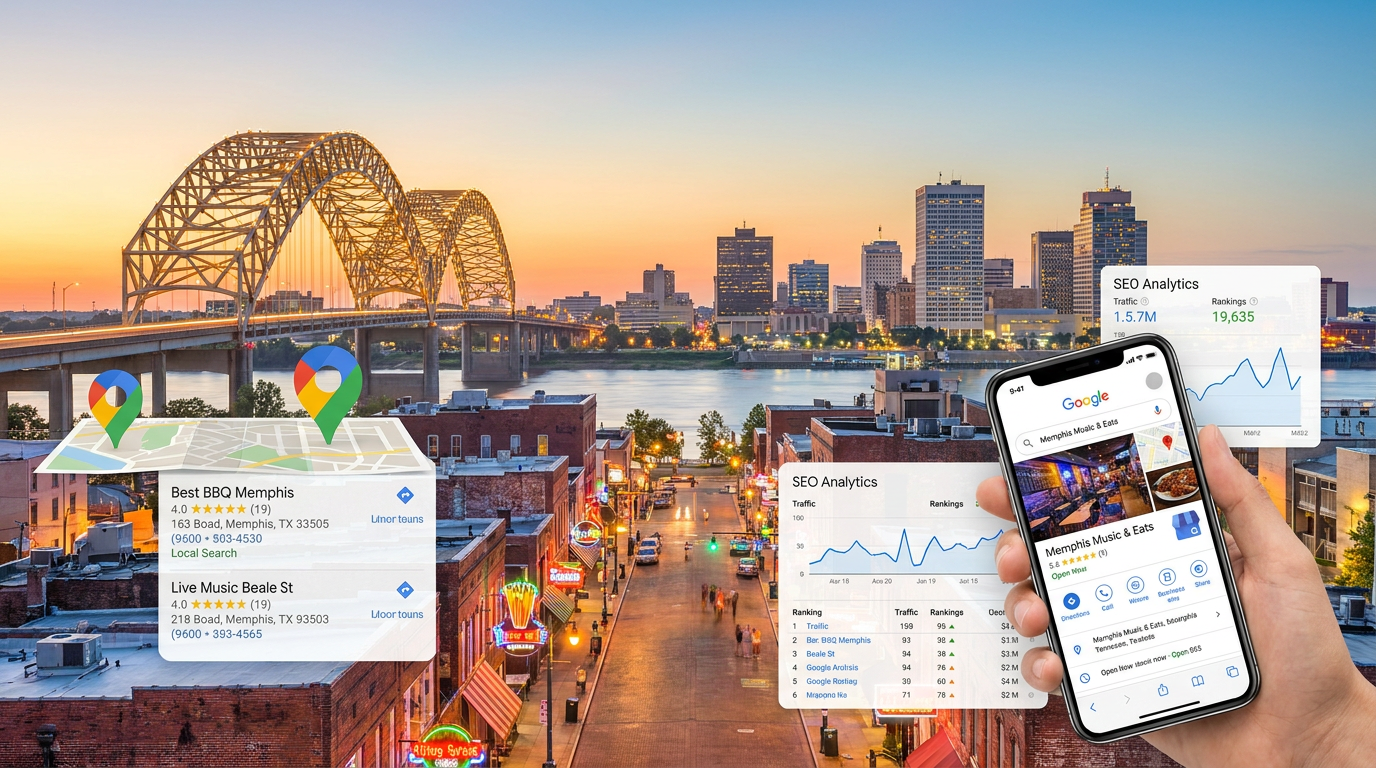
Let's get straight to the point. When someone in Memphis pulls out their phone and types "plumber near me" or "best barbecue in Midtown" or "hair salon Germantown," a handful of businesses show up at the top of Google. Everyone else might as well be invisible.
That top spot isn't luck. It's local SEO. And if you're a small business in Memphis that depends on local customers, it's the single most important thing your online presence can do for you.
The good news? You don't need a marketing degree or a massive budget to get it right. You just need to know what actually moves the needle — and what's a waste of your time.
What Is Local SEO and Why Should You Care?
Local SEO is how Google decides which businesses to show when someone searches for something in a specific area. It's the reason three businesses pop up on that map at the top of the search results — what marketers call the "Local Pack" or the "Map Pack."
If your business is in that map pack, you're getting clicks, calls, and foot traffic without paying for a single ad. If you're not, your competitors are getting all of that instead.
For Memphis small businesses, local SEO is especially powerful because the competition isn't as fierce as it is in cities like Nashville or Atlanta. That means a little effort goes a long way. The businesses that take local SEO seriously right now are going to own their market for years.
Step One: Nail Your Google Business Profile
If you do absolutely nothing else on this list, do this one. Your Google Business Profile is the foundation of your local SEO. It's the listing that shows up on Google Maps and in the map pack when people search for businesses like yours.
Here's how to make it work for you.
Claim and verify it. You'd be shocked how many Memphis businesses either haven't claimed their Google Business Profile or set it up years ago and forgot about it. Go to business.google.com and make sure you own yours.
Fill out every single field. Business name, address, phone number, hours, website, services, description — all of it. Google rewards complete profiles. A half-filled listing tells Google you're not serious, and it ranks you accordingly.
Pick the right categories. Your primary category is one of the biggest ranking factors in local search. Don't just pick "contractor" when you could pick "roofing contractor." Be as specific as possible, and add secondary categories that cover your other services.
Post regularly. Google Business Profile lets you publish posts — updates, offers, events, photos. Most businesses ignore this completely, which is exactly why doing it gives you an edge. Even one post a week signals to Google that your business is active and engaged.
Step Two: Get Reviews and Actually Respond to Them
Reviews aren't just for making you look good. They're a direct ranking factor. Businesses with more positive reviews rank higher in local search. Period.
But here's the part most people miss: responding to reviews matters almost as much as getting them. When you reply to a review — even a simple "Thanks, we appreciate your business!" — Google sees an active, engaged business owner. That matters.
Make it easy for your customers to leave reviews. Send a follow-up text or email with a direct link to your Google review page after every job. Don't be shy about asking. Most happy customers are glad to help — they just need a nudge.
And when you get a negative review? Don't ignore it and don't get defensive. Respond professionally, address the issue, and move on. How you handle a bad review tells future customers more about your business than the review itself.
Step Three: Make Sure Your Name, Address, and Phone Number Are Consistent Everywhere
This sounds boring, and it is. But it's critical.
Google cross-references your business information across the internet. Your name, address, and phone number — marketers call this your NAP — need to be exactly the same everywhere they appear. Your website, your Google Business Profile, Yelp, Facebook, the Better Business Bureau, local directories, all of it.
If your website says "123 Main Street" but your Facebook page says "123 Main St." and Yelp has an old phone number, Google gets confused. And when Google gets confused, it doesn't rank you.
Do an audit. Search your business name online and check every listing. Fix anything that's outdated or inconsistent. It's tedious work, but it pays off quietly in the background every single day.
Step Four: Build a Website That Google Actually Likes
Your website is the hub that everything else connects to. If it's slow, outdated, or not mobile-friendly, it's dragging down your entire local SEO effort.
Here's what Google wants to see from your site.
Fast load times. Under three seconds. If your site is built on a bloated template with a dozen plugins, it's probably not hitting that mark.
Mobile-first design. Most local searches happen on phones. If your site doesn't look and work great on a phone screen, Google notices — and so do your customers.
Location-specific content. Your site should make it crystal clear where you operate. Mention Memphis, your specific neighborhoods, and your service areas naturally throughout your pages. A page titled "HVAC Services in Bartlett, TN" ranks for Bartlett searches. A generic "Our Services" page doesn't rank for much of anything.
Structured data markup. This is the behind-the-scenes code that tells Google exactly what your business is, where it's located, and what you offer. Most template websites don't include this properly. A custom-coded site can have it baked in from the start.
Step Five: Create Content That Answers Local Questions
When someone in Memphis searches "how much does a new roof cost in Tennessee" or "best time to service your AC in the South," Google is looking for content that answers those questions. If your website has a blog post that nails it, you're the one showing up.
You don't need to become a full-time blogger. Even one or two solid posts a month that answer real questions your customers ask can make a significant difference. Think about what people call and ask you every week — then turn those answers into blog posts.
The businesses that show up in local search aren't just optimized. They're helpful. Google's job is to connect people with the most useful answer, and if that answer lives on your website, Google is going to send people your way.
Local SEO Isn't a One-Time Thing
Here's the honest truth: local SEO isn't something you set up once and forget about. It's an ongoing effort. Reviews need to keep coming in. Your Google Business Profile needs fresh posts. Your website needs to stay fast and relevant. The businesses that stay consistent are the ones that stay on top.
But it doesn't have to eat up your whole week. A smart website and a simple routine can handle most of the heavy lifting for you — especially when AI tools are working behind the scenes to keep things running smoothly.
Let's Get You Found
At Smart Web Memphis, we build websites and local SEO strategies that put Memphis small businesses on the map — literally. From Google Business Profile optimization to custom websites built for local search, we help you show up where it matters most.
Your customers are searching for you right now. Let's make sure they find you.
Smart Web Memphis — Smarter websites for harder-working businesses.